Every week I sit down with parents from Coconut Creek, Parkland, Coral Springs, and Margate who tell me some version of the same story. Their child is smart, sweet, and a little bit lost. Maybe they're glued to a screen. Maybe they're shy and shrinking at school. Maybe they're the opposite — big feelings, no volume knob, meltdowns over homework. The parent has already tried a season of soccer, a semester of dance, maybe a summer of gymnastics. Something is still missing.
Martial arts keeps coming up in the group chats and neighborhood Facebook posts, so they start looking. And that's usually where the confusion begins. Every school in South Florida promises confidence, discipline, and respect. So how do you actually choose?
This is the honest walkthrough I wish more Coconut Creek parents got before signing anything. No hype, no hard sell. Just what to look for, what to ignore, and how to know if your child is one of the kids this really works for.
Every martial arts school promises confidence. The good ones can show you the drill that builds it.
Why Coconut Creek Parents Are Choosing Martial Arts Right Now
Coconut Creek is a family town. Great schools, tight neighborhoods, a lot of kids in organized activities from age four onward. But the last few years have shifted something. Parents I talk to are less worried about their kid being busy, and more worried about their kid being centered.
That's the shift. It's not "my child needs another activity." It's "my child needs an environment that builds them." Team sports are great for teamwork. Dance is great for expression. But there's a specific set of qualities — focus, respect, calm under pressure, the ability to lose and come back — that martial arts trains directly, on purpose, every single class.
Here's what parents in our area consistently tell me they're looking for:
- A calmer, more focused kid at homework time.
- A polite kid who makes eye contact and greets adults.
- A confident kid who is not a bully and not a target.
- An activity where the child cannot hide in a crowd of 22 teammates.
- A coach who actually knows their child's name after three classes.
That's a real list. And a well-run martial arts school can deliver on all five, faster than most parents expect.
What Kids Martial Arts Actually Teaches (Beyond Kicks and Punches)
Here is the honest truth after 20-plus years of coaching kids. The techniques matter, but they are the vehicle, not the destination. What we are really training is a nervous system.
Every kids class is a controlled loop of the same four beats: instruction, effort, correction, effort again. Repeat that loop two or three times a week and something changes in how a child handles frustration everywhere else — in the classroom, at the dinner table, on the driveway when the scooter falls over for the tenth time.
The four skills that transfer to real life
- Focus on demand. A kid who can hold a stance for 45 seconds while the instructor talks can hold attention through a math worksheet.
- Calm under pressure. A kid who has been gently grabbed, pushed, and had to problem-solve on the mat does not panic when a classmate shoves them in line.
- Respectful communication. "Yes, sir. Yes, ma'am. Thank you." Repeated 40 times a class becomes muscle memory for how to talk to adults.
- Resilience with a floor. Losing a round is not a catastrophe when the coach immediately walks you through what to try next time. Kids learn that struggle is information, not identity.
Choosing a Kids Martial Arts School in Coconut Creek: What to Look For
Coconut Creek and the surrounding towns — Parkland, Coral Springs, Margate, Pompano Beach, Lighthouse Point — have plenty of options. That is good news and bad news. Good, because you have choices. Bad, because a lot of schools look the same on the website.
Here is the checklist I would use if I were the parent.
1. Get your child on the mat, don't just watch from a chair
You cannot judge a martial arts school from the lobby. Kids are not sample chocolates — they don't know if they like it until they've actually done it. The right way to evaluate a school is to have your child participate in a real class, in a real uniform, with the actual coach and the actual students they'd train with. That's exactly why our intro is built the way it is: two weeks of real classes, not a five-minute demo. You watch your child in the environment, and — more importantly — your child gets to feel it in their own body. Meltdown or lit up, you'll know by the end of week one.
2. Ask what the class ratio is
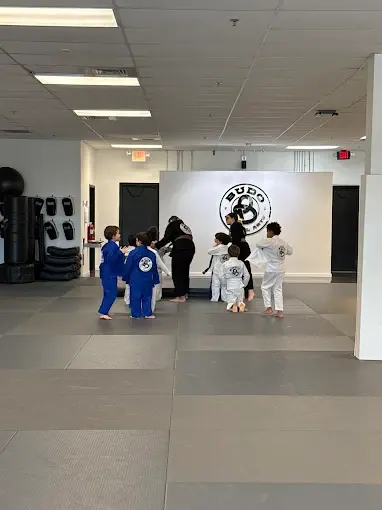
For kids ages 5 to 12, you want to see one instructor per twelve to fifteen students, with an assistant on the floor whenever possible. Above that, individual correction disappears. Below that, the child gets seen every class. In a town like Coconut Creek where schools are pushing 25 kids per classroom, the mat should feel like a relief, not more of the same.
3. Ask about the curriculum, not just the belts
A good kids program is structured. There is a curriculum. Kids know what they are working on for the next belt and why. If the answer to "what will my child learn in the next 90 days" is fuzzy, keep looking.
4. Watch how the instructor handles a kid having a bad day
This is the single best test. Every class, at least one kid melts down, tunes out, or starts messing with the kid next to them. Watch what the coach does. A great instructor addresses it calmly, redirects the child, and moves on. A mediocre one embarrasses the kid or ignores it. That single moment tells you more than any brochure.
5. Talk to two current parents (not the ones the school picks)
Hang around after class. Ask a real parent, "has this actually changed anything at home?" Their answer, unrehearsed, is worth more than a hundred five-star Google reviews.
Which Style is Best for Kids? BJJ, Muay Thai, Karate, or a Mix?
Parents ask this constantly, and the honest answer is: for kids, the style matters less than the coach and the curriculum. That said, here is how I break it down for local families.
Brazilian Jiu-Jitsu (BJJ) for kids
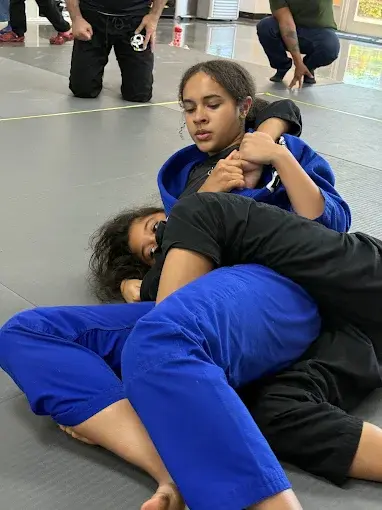
Great for confidence and real-world self-defense. BJJ is grappling, so kids learn to stay calm when someone is close to them, control an untrained aggressor, and end a situation without throwing a punch. Excellent for shy kids and for kids who tend to be targets. Also — and this matters — most bullying in elementary and middle school ends up on the ground. BJJ is the answer for that reality.
Muay Thai and kickboxing for kids
Great for cardio, coordination, and confidence with striking. In our kids program the sparring is heavily controlled and gear-heavy. Kids learn to move their feet, throw a clean punch, and take a light shot without flinching. Fantastic for high-energy kids who need to burn something off in a productive way.
Traditional karate or taekwondo for kids
Very structured, uniform-heavy, and belt-focused. Some kids thrive in that formality. Others outgrow it around age 10. Nothing wrong with it — just know what you are buying.
Our approach at Budo
We blend BJJ as the foundation with Muay Thai and self-defense elements woven in as kids get older. The goal is a child who is genuinely capable — not a child who has memorized a form. Learn more about our mix on our classes page.
What Age Should My Child Start Martial Arts?
The best age to start depends on the child, not the calendar. Here is a rough map based on what I actually see work in Coconut Creek families.
Ages 3–4 (Tiny Ninjas)
This age is not about martial arts. It is about listening skills, following directions, and taking turns. Classes are short, playful, and built around gross-motor development. If your preschooler can sit through a 30-minute class and go home tired and proud, you are winning.
Ages 5–7 (Lil Ninjas)
The sweet spot for building the base. Kids at this age are physically ready for real technique and mentally ready for real class structure. Two classes a week here creates the biggest jump in behavior at home.
Ages 8–12 (Jr. Warriors)
This is where martial arts starts to feel like a life skill instead of an activity. Kids can spar lightly, help teach younger students, and start to identify as a martial artist. The confidence transfer to school and friendships is very visible in this range.
Ages 13+ (Teens)
Never too late. Teenagers who start in high school often develop faster than kids who have been in for years, because they can absorb concepts quickly and they choose to be there. If your teen is drifting toward the screen and away from sports, this is the intervention.
How Often Should Kids Train? The Honest Answer
One class a week is exposure. Two classes a week is training. Three classes a week is when parents start telling me their child seems like a different person.
I know that sounds like a sales pitch. It is not. It is a neurological reality. The behavioral loops we build on the mat need a second and third rep in the same week to consolidate. One session a week gets erased by five days of regular life. Two sessions holds. Three sessions compounds.
For Coconut Creek families juggling school, homework, and a second sibling's activities, two classes a week is the realistic sweet spot. Pick a Tuesday and a Thursday. Protect them. Watch what happens in eight weeks.
What Kids Martial Arts Costs in Coconut Creek (and What to Watch For)
Reasonable pricing for a well-run kids program in our area lands somewhere between $150 and $220 a month for unlimited classes, plus a uniform and a testing fee a few times a year. If a school is dramatically cheaper, ask what the class ratios look like. If it is dramatically more expensive, ask what you are getting for that premium.
Watch for these red flags in a contract:
- A long-term contract before you have taken a single class.
- Belt tests that cost more than $75 for a kids program.
- Vague answers about what happens if you need to pause for injury or vacation.
- Big upfront "gear packages" that you do not actually need for the first three months.
None of these are automatic dealbreakers, but they are conversations worth having before you sign.
A Realistic Timeline of What Changes at Home
Here is what parents in our program tend to report, in order.
- Weeks 1–2: The child is tired in a good way. Sleeps better. Talks about class at dinner.
- Weeks 3–6: Better listening the first time. Fewer meltdowns over small transitions. Starts using words like focus and respect on their own.
- Weeks 6–12: Homework battles ease up. Teachers mention improved attention. Child stands taller in group photos.
- Months 3–6: Real identity shift. The child sees themselves as a martial artist. Handles a bad day at school without collapsing. Sticks up for a friend appropriately.
- Months 6–12: Character-level changes. Grit. Follow-through. A base level of confidence that does not depend on other people's approval.
Frequently Asked Questions
Is martial arts safe for young kids?
In a well-run program, yes. Kids under 12 do very little hard sparring in our classes. Most of the training is drilling technique, controlled positional games, and light partner work with an instructor watching every rep. Serious injuries in a good kids program are extremely rare — statistically safer than youth soccer or gymnastics.
My child is shy. Will they hate it?
Shy kids often thrive here. The environment is structured and predictable, the instructor introduces them one-on-one, and there is no crowd to hide in or get lost in. Most of our shyest students blossom by class four or five.
My child is aggressive. Won't martial arts make it worse?
This is one of the most common misconceptions. In practice, the opposite happens. High-energy or aggressive kids finally have a place where their body can work hard and their impulses have structure. Within a couple of months, most calm down significantly. A tired, respected kid is a well-behaved kid.
How is Budo different from other schools in Coconut Creek?
Two things. First, we keep class ratios small on purpose — every kid gets seen every class. Second, we teach a blend of BJJ, Muay Thai, and real self-defense instead of one narrow style, so kids leave capable, not just credentialed. You can read more on our about page.
Do you offer a trial?
Yes. Two weeks of classes for $29, with a money-back guarantee. It is the cleanest way to know if the school and the child are a fit before committing to anything longer.
The Bottom Line for Coconut Creek Parents
You do not need another activity on the calendar. You need the right one. For a lot of kids in our area, martial arts is that one — not because of the kicks and the belts, but because of the repeated loop of effort, correction, and respect that changes how they carry themselves everywhere else.
If any of this sounds like your child, come watch a class. Bring your kid. See if they light up or shut down in the first ten minutes. That is your answer.
New Student Experience
Ready to See It In Person?
2 Weeks of Classes — $99 $29
Training near you: martial arts near Parkland