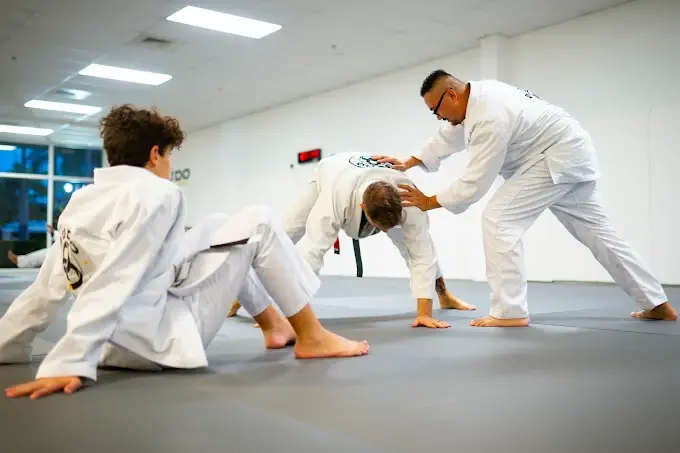
The first time you try Brazilian Jiu Jitsu as an adult, you will probably end up on your back with someone calmly holding you there. That is not a sign you are bad at it. It is how almost everyone starts. BJJ rewards position, leverage, and timing, and those take a while to learn no matter how strong or fit you are.
This guide is for adults near Coral Springs who are thinking about starting BJJ for themselves. If you are choosing a class for a child, our family guide to BJJ near Coral Springs covers that separately. Here we focus on what a grown-up beginner can expect, how to behave on the mat, what to ask, and how to pick a school you will actually keep attending. Budo Martial Arts is at 5901 Lyons Road in Coconut Creek, just outside Coral Springs, and our adult BJJ program is for teens and adults 13 and up.
What adult BJJ is, in plain terms
Brazilian Jiu Jitsu is a grappling art. Instead of striking, you work to control another person on the ground: get to a better position, escape a bad one, and finish with a submission such as a joint lock or choke. The other person can tap, meaning they signal with their hand or voice, and the action stops right away.
Two things make BJJ different from many activities adults try. First, much of it is practiced against a partner who is actually resisting, at least in some rounds. Second, good position and leverage can help a smaller person handle a larger partner, although size and strength still matter. That is a big part of why adults stick with it. It is a puzzle that keeps changing.
How a first adult class often runs
Schools organize class differently, so ask how a beginner class is structured where you plan to train. A common outline looks something like this:
- A warmup built around BJJ movements, such as shrimping (scooting your hips away on your back), technical stand-ups, and breakfalls.
- A technique for the day, demonstrated by the coach and then drilled with a partner at a slow pace.
- Positional drilling, where you start in a set position with a simple goal, like escaping or keeping control.
- Live rolling for those who are ready, which is the BJJ version of sparring.
- A short review, then a handshake or fist bump with your partners.
In your first class, the drilling part matters most. You will be close to another person, often in positions that feel unusual. Move slowly, ask the coach to show you again, and do not worry about getting it right the first time. Almost nobody does.
Rolling and how to approach it
Rolling is where things click, and also where new adults get hurt when they rush. Ask the coach when beginners start rolling and how partners are chosen. Many schools pair new students with experienced, calm partners first. Tell your partner it is your first time. Good training partners will slow down.
Tap early. If something feels uncomfortable, tight, or confusing, tap. There is no prize for holding out. And when your partner taps, let go immediately. That single habit is what keeps a BJJ room safe for everyone.
If you are bigger or stronger than your partner
Size and strength can feel like an advantage in your first rolls, and they can also get people hurt. Explosive movements, cranking on a lock, or dropping your full weight on a smaller partner are the habits coaches spend the most time correcting in new adults. Try to move at the pace of the drill, use technique even when it fails, and ask your partner to tell you if you are going too hard. You will learn more, and people will want to train with you.
Mat etiquette that actually matters
Every school has its own customs, but a few rules show up almost everywhere. Following them earns you respect quickly:
- Show up clean. Wash your gi or training clothes after every class and shower before training.
- Trim fingernails and toenails. Long nails cut people.
- No shoes on the mat, and wear sandals or shoes off the mat. Do not walk barefoot into the bathroom and then onto the mats.
- Take off jewelry, including rings and watches.
- Cover any cuts, and stay home if you are sick or have a skin issue.
- Ask a coach before you try anything that was not taught, especially submissions you saw online.
- Let the coach coach. If a partner is new too, focus on your own drill.
You might also see a bow when people step onto the mat, or a lineup by belt at the start or end of class. Customs like these vary. Watch what others do and follow along.
Ego, age, and starting as an adult
The biggest adjustment for most new adults is mental. You may be good at your job, strong in the gym, or used to picking things up fast. In BJJ, someone half your size can control you in week one. That is not humiliation. It is information about how much there is to learn.
Adults start BJJ at many ages. If you have an old injury, a stiff back, or a condition you manage, tell the coach before class so drills can be adjusted. If you have a medical concern or are returning to exercise after a long break, it makes sense to check with your doctor before starting any demanding training. Choose partners carefully at first, and do not try to keep up with the fittest person in the room.
Expect to be sore in odd places, like your forearms, neck, and fingers. That usually eases as your body gets used to gripping and moving on the ground.
Gi, no-gi, and what to wear
BJJ is trained in two main ways. In gi classes, you wear a heavy cotton jacket and pants with a belt, and you can grip the fabric. In no-gi classes, you wear a rash guard and shorts or spats, and grips change. Ask which style a school teaches for beginners.
At Budo, our current adult BJJ intro includes a BJJ gi. For your first visit, ask what to wear before you get your gi, whether to bring water, and where to change. If you prefer no-gi training, ask about that too.
Questions to ask before you sign up
- What does a beginner do in the first few classes?
- When do new students start rolling, and how are partners matched?
- How do coaches watch for safety during live rounds?
- Is the beginner curriculum structured, or is each class different?
- Who teaches the adult classes, and what is their background?
- Are teens and adults ever in the same class, and how is that handled?
- What should I do if I need to skip rolling for a while because of an injury?
- Is competition expected, or optional?
Budo describes its adult BJJ program as black-belt-led, and our founder, Charlie Vinch, is part of the welcome for new adult students. Wherever you visit, it is reasonable to ask who will actually be coaching you week to week.
How to choose a school that fits
There are good BJJ schools across South Florida, and the best one for you depends on what you need. A few things are worth watching during a visit or trial class:
- Coaches correct beginners during drills, not only from the front.
- Higher belts roll with control and help new students.
- The room feels calm, even when people are training hard.
- Questions are welcome, including basic ones.
- Nobody pressures you to roll hard, compete, or sign up on the spot.
- The training style matches your goals, whether that is self-defense, fitness, competition, or simply learning something new.
If you can, watch a class before your first session. Notice how the coach starts class, how beginners are spread through the room, and how people treat each other between rounds. Then take an intro class and compare what you saw with what it felt like to be on the mat.
Getting to Coconut Creek from Coral Springs
Budo is in Coconut Creek, not Coral Springs, so you will be driving to the next city over. Many people compare routes along Sample Road or Wiles Road toward Lyons Road. Your drive depends on where you start and when you leave. Check live directions from work or home at the time you would actually head to class, on a real weekday, instead of relying on a general estimate.
If you have kids who might want to train too, our Coral Springs page explains the children's programs, and families sometimes plan around a single trip.
Consistency beats intensity
BJJ is slow to learn, and progress comes from showing up regularly. A schedule you can keep through busy weeks will teach you more than a burst of daily training followed by a month off. Pick class days you can protect, and give yourself several weeks before deciding whether BJJ is for you. The first few sessions are mostly about learning the rules of a new environment.
Price and commitment questions
Budo currently offers a $29 adult BJJ intro for two weeks of classes, which includes a BJJ gi. For anything beyond the intro, ask the school directly: what options are available after the intro, whether there is a contract and how long it lasts, how canceling or pausing works, and whether there are added costs later for gear or belt promotions. Get important terms in writing before you sign.
Judging your first class
Afterward, ask yourself a few honest questions. Did you learn one or two things you could explain to someone else? Did your partners treat you well? Did the coach notice you and check in? Did you feel safe tapping? If the answers are mostly yes, give it a few more classes. The first one is the hardest to judge, because everything is unfamiliar.
If something bothered you, mention it to the coach. A good school wants to know.
First-class checklist
- Confirm the class time and that it is a beginner-friendly adult class.
- Ask what to wear and what the intro includes.
- Trim nails, remove jewelry, and bring water and sandals.
- Arrive early and tell the coach about injuries.
- Tell partners it is your first class.
- Tap early, and release immediately when your partner taps.
- Check the drive from Coral Springs at your real departure time.
- Plan your next two or three classes before judging the fit.
New Student Experience
Ready to See It In Person?
2 Weeks of Classes: $99 $29
Training near you: martial arts near Coral Springs
Keep Reading
Muay Thai
Muay Thai in Coconut Creek: What Beginners Should Know Before Their First Class
Parent Guide
How to Choose a Kids Martial Arts Class Near Coral Springs
School Owner Perspectives
BJJ vs. Traditional Martial Arts Schools: The Media Changed. Did Your Business?
Parenting